

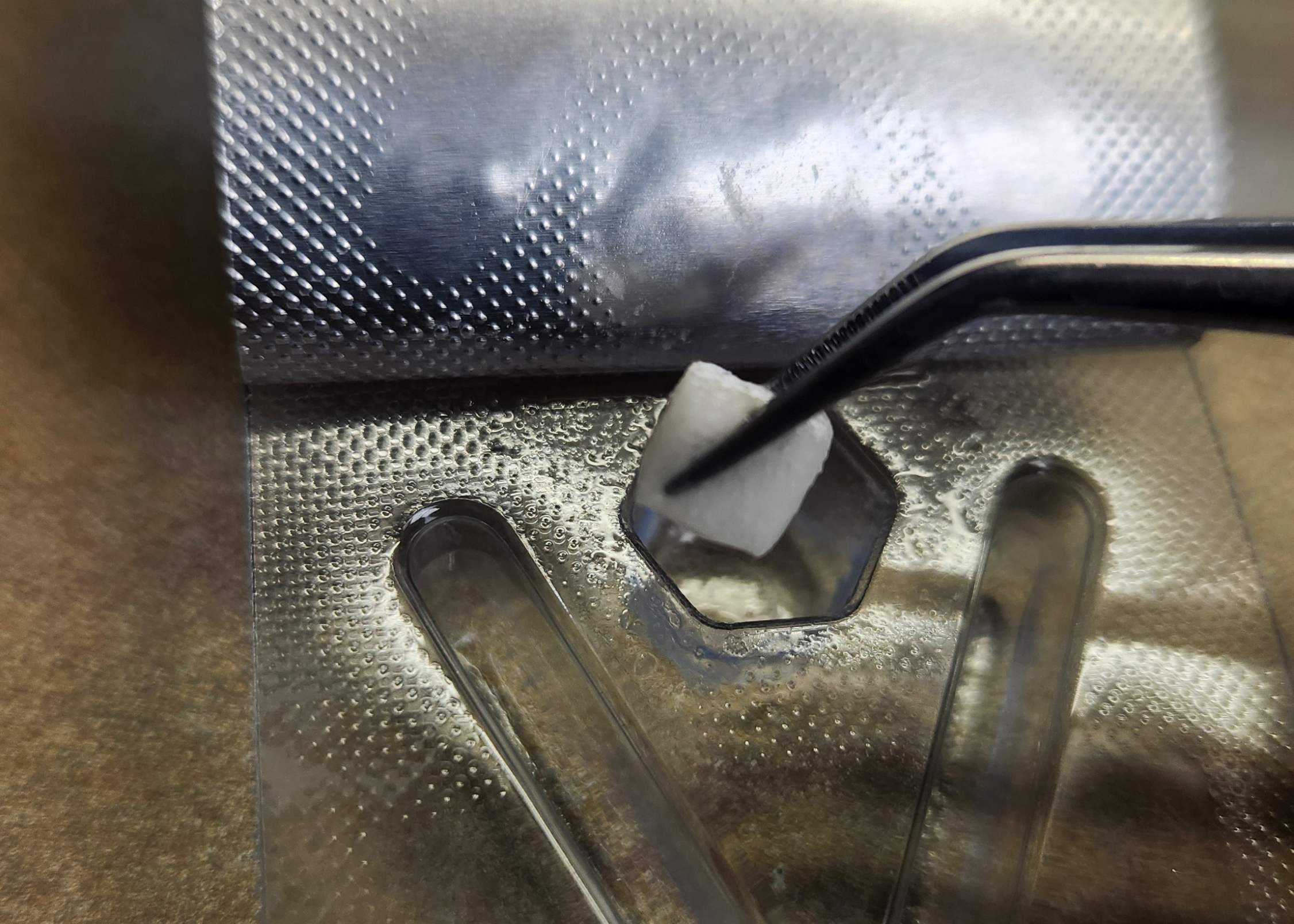
What in the world is this little sponge?
Every once in a while, something comes along in dentistry that makes me stop and say:
“Okay… now THAT is interesting.”
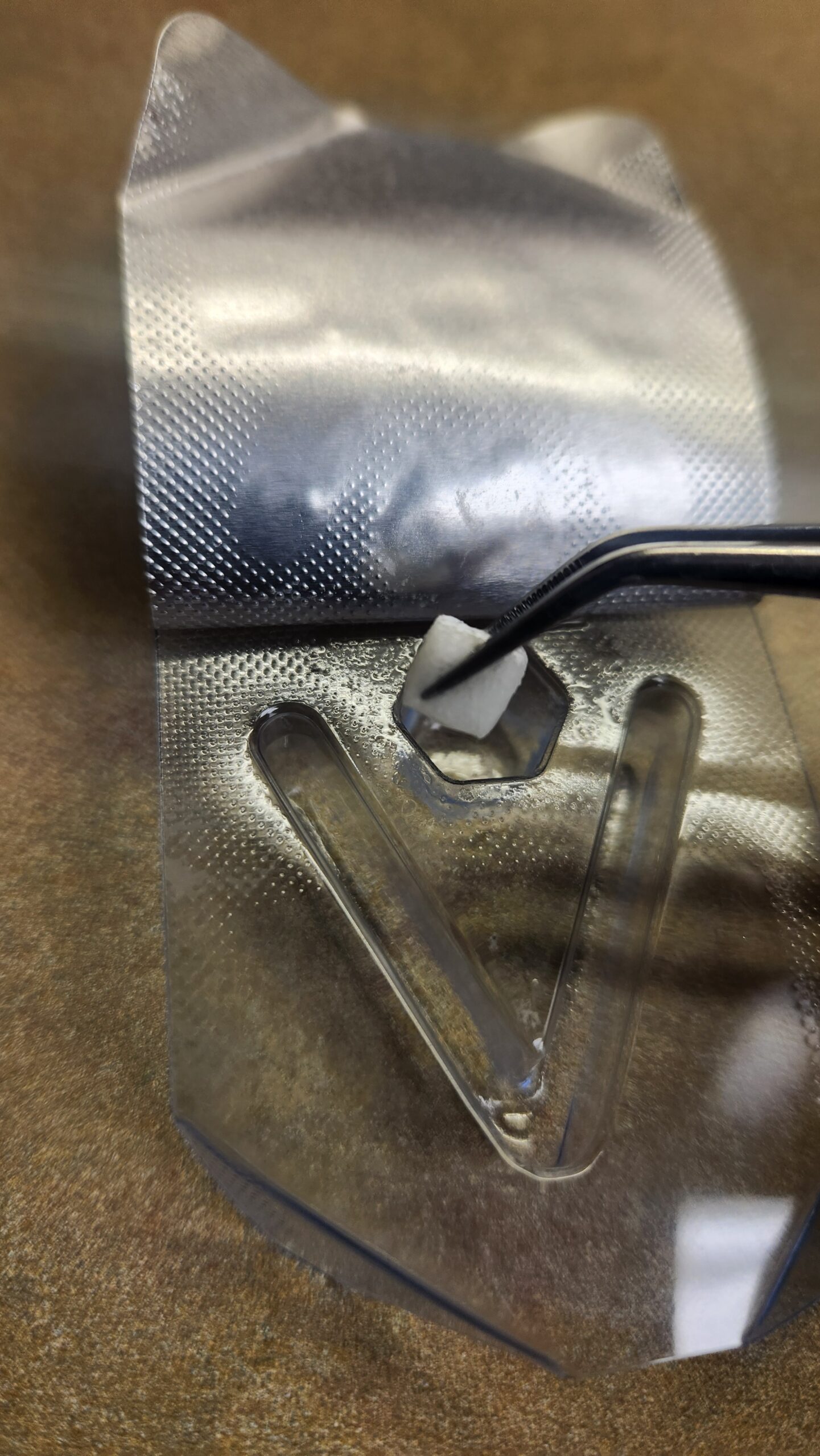
This little sponge is one of those things.
For more than 30 years, when we found the beginning stages of tooth decay, the conversation was usually pretty simple. If the area was small enough, we could watch it, improve home care, use fluoride, and see if it progressed.
If the decay became large enough to require treatment, we removed the damaged tooth structure and placed a filling.
But what if there were another option?
What if we could identify enamel damage early enough and actually help the tooth repair itself before a traditional filling becomes necessary?
That is where a newer approach using self-assembling peptide technology gets very interesting.
What Is Self-Assembling Peptide Treatment?
The material in the photo may not look particularly exciting. It is a tiny sponge used to deliver a peptide-based treatment to an area of early enamel decay.
But the science behind it is much more interesting than the sponge itself.
Early tooth decay begins when minerals are lost from the enamel. At this stage, the tooth may have an early lesion or weakened area without having a large, established cavity that requires drilling and filling.
Self-assembling peptides are designed to work within these early areas of damaged enamel. The peptide creates a microscopic framework that can support the natural remineralization process, helping minerals from the surrounding environment rebuild within the weakened enamel.
In other words, instead of immediately removing tooth structure, the goal is to give the tooth an opportunity to repair an early area of damage.
And as a dentist who has spent his career trying to preserve as much natural tooth structure as possible, that gets my attention.
Why Finding Cavities Early Matters
There is an important catch: this isn’t a replacement for fillings.
Once decay has progressed too far and a true cavity has developed, we still need to remove the damaged tooth structure and restore the tooth. No sponge, peptide, toothpaste, or other product is going to magically rebuild a tooth that has already lost significant structure.
The opportunity is earlier in the process.
That’s one reason we’ve become increasingly interested in technology that helps us identify subtle changes in teeth as early as possible.
At Fear Free Dental, we use digital imaging and AI-assisted dental technology as additional tools when evaluating our patients’ X-rays. The dentist still makes the diagnosis, but these tools can help draw our attention to areas that deserve a closer look.
Now we’re asking another question:
If we can find certain enamel changes earlier, can we intervene earlier too?
That combination is what makes this technology particularly interesting to me.
Could This Mean Fewer Fillings?
Potentially, for the right patient and the right tooth.
Our philosophy has always been that natural tooth structure is worth preserving whenever we safely can. Every time we prepare a tooth for a restoration, some natural tooth structure has to be removed.
Sometimes that’s absolutely necessary. If you need a filling, you need a filling.
But if we can identify an early lesion before it reaches that point and use a treatment that encourages remineralization instead, we may be able to delay or potentially avoid restorative treatment in appropriately selected cases.
That’s a meaningful change from simply waiting to see whether an early lesion gets worse.
Is This a “Miracle Cure” for Cavities?
No, and that’s important.
I’m a bit of a science geek, but I’m also pretty skeptical when a new dental product promises to revolutionize everything. I’ve been practicing dentistry for more than 30 years. I’ve seen plenty of products come and go.
That’s why we’re approaching this the way we approach any new technology in our office: look at the science, understand where it is appropriate, and evaluate how it performs in real patients.
Self-assembling peptide technology isn’t meant to replace good brushing, flossing, fluoride, regular dental care, or restorative dentistry when a tooth truly needs it.
What interests me is its potential to give us another tool for treating early enamel decay before more invasive treatment is necessary.
A Different Conversation About Cavities
Dentistry has changed tremendously over the course of my career.
We’re better at seeing things earlier. Our imaging is better. Our materials are better. And increasingly, we’re looking for ways to preserve rather than remove healthy tooth structure.
That’s why this tiny sponge is so interesting.
For decades, the conversation around a suspicious area of enamel has often been:
Do we watch it, or do we drill it?
Now, in certain situations, we may have another question to ask:
Can we help the enamel repair itself?
We’re currently putting this technology through its paces here at Fear Free Dental in Portland, Oregon, and I’m looking forward to seeing where it fits into the way we care for our patients.
I’ll keep you posted on what we learn.
I have a feeling this tiny little sponge is going to lead to some very interesting conversations about how we treat early cavities.
— Dr. Steven Little